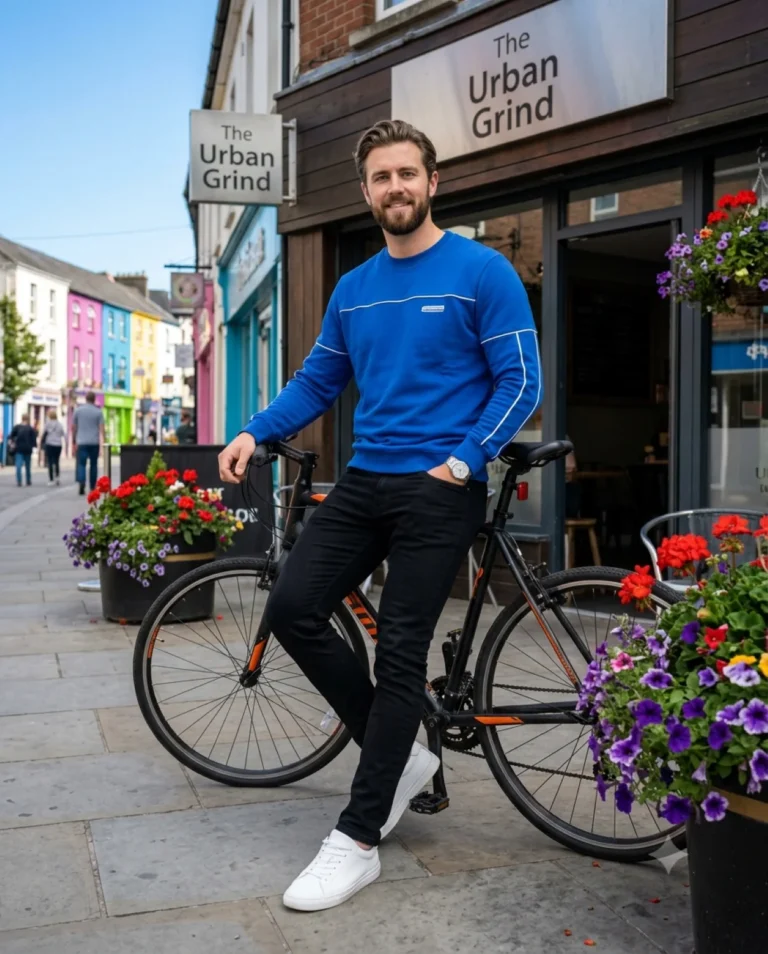

Social media campaigns, fashion blog headers, character design reference, digital lookbooks, and advertising visuals.
Create a stylish young woman outdoors with a bright carefree smile. Use the attached reference photo for facial identity and preserve exact proportions. She stands casually with one hand touching her hair and her body turned slightly toward the camera. She wears a fitted black leather jacket over a soft neutral top with relaxed denim jeans. The setting is an open urban street with soft greenery and warm natural elements in the background. Golden hour sunlight creates a glowing atmosphere with soft highlights and natural skin tones. Cinematic fashion photography style with a modern editorial feel and authentic candid energy. Shot on a full-frame DSLR with an 85mm lens, shallow depth of field, crisp facial detail, soft background bokeh, ultra-realistic quality. Aspect ratio 4:5.
Pivoting creative or freelance services and Filtering 'Shiny object' marketing Trends
Based on what you know about me, my business, and my goals, I'm going to share [number] business ideas or directions I'm considering. For each one, score it out of 10 against these three criteria: alignment with my strengths, market demand, and my personal energy for this idea. Present the results in a table and tell me which option you recommend I go all in on, and why. Ask for more detail if required.
Perfect for Hero visuals, phone wallpaper and social media campaign
Generate a highly realistic close-up portrait of a young woman sitting on green grass in a sunny open field. Use the attached reference photo for facial identity and preserve exact proportions. She slightly leans toward the camera with a casual selfie-style pose and gently pouts her lips with a playful relaxed summer expression. She casually holds a smartphone in one hand while looking naturally into the camera. She wears a white sleeveless tiered summer dress and oversized round sunglasses with dark lenses. Her long dark brown hair flows naturally in the breeze with soft movement. Natural makeup with soft coral-red lips and realistic skin texture. The environment is a vibrant open grass field under a clear blue sky with a few softly blurred trees in the background. The atmosphere feels carefree, summery, and uncluttered with an airy natural feel. Bright natural daylight with direct sunlight and soft realistic shadows. Warm skin tones, vibrant greens, and realistic outdoor color balance. No artificial lighting. The overall style is hyper realistic candid lifestyle photography with a spontaneous real-life smartphone photo feel. Natural perspective, subtle depth of field, and authentic skin details. Avoid any fashion editorial styling or cinematic grading. Keep the moment unposed and effortless. Shot on a 28-35mm smartphone-style lens with mild wide-angle distortion and realistic facial proportions. Slightly low angle close-up to medium close-up composition. Vertical 9:16 framing with the subject dominating the frame. Ultra-sharp focus, ultra-detailed textures, realistic outdoor lighting, and natural candid photography aesthetic.
Corporate Headshot, LinkedIn Portrait and Professional Portrait
Create a professional chest-up portrait captures a composed figure in a confident thinker’s pose, with one hand resting against the chin and a steady gaze locked directly into the camera. The expression is calm, controlled, and intentional, while the slight body angle adds subtle depth without breaking the direct connection of the face.
The subject wears a fitted black crew-neck t-shirt with a clean matte finish that keeps attention on form and expression. Thin metal-framed glasses add a refined edge, sitting lightly on the face with subtle lens reflections that enhance realism without distraction. On the raised hand, a dark metallic wedding band and a bold stainless steel chronograph watch stand out as strong but minimal accents, reinforcing a polished and intentional style.
The background is a deep charcoal studio backdrop with a soft, textured tone and a gentle vignette effect that naturally draws focus toward the subject. Lighting is carefully controlled in a three-point studio setup, with a strong key light shaping the face and upper body, while soft shadows define the jawline and hand position, adding structure and depth.
Shot in a tight medium close-up using an 85mm lens, the image maintains a shallow depth of field that keeps the eyes and wrist details sharp while allowing the rest to softly fall off. The final look is crisp, high contrast, and visually disciplined, built around clarity, texture, and controlled lighting. Aspect ratio 4:5.
Rapid prototyping, building single-purpose developer tools, and automating local workflows without the bloat.
Prompt:
Create a complete command-line application using Python.
The application should solve this problem:
[Clearly describe the problem in 1–2 sentences.]
Core features:
[Feature 1 with exact behavior]
[Feature 2 with exact behavior]
[Feature 3 with exact behavior]
Technical requirements:
Use a clean and modular structure with functions or classes
Use argparse (or click if specified) for CLI input handling
Store data using [JSON / SQLite / file system]
Handle edge cases and invalid inputs properly
Output requirements:
Provide full working code in a single file (or structured files if needed)
Include setup and run instructions
Show example commands and expected output
Keep the code production-ready, not a prototype
Constraints:
Do not use unnecessary external libraries
Prioritize readability and maintainability
Viral style replication, Competitor video analysis, and Retention optimization
Act as a professional video editor and visual style analyst.
I will provide a reference video. Analyze it and extract its complete editing system across these dimensions:
Pacing: average shot length (seconds), rhythm pattern, cut frequency (cuts per 10 seconds)
Transitions: type, frequency, and exact context where each is used
Color grading: contrast level, saturation (low / medium / high with reference), temperature shift, overall mood
Sound design: BPM estimate, music vs SFX dominance (music-led / balanced / SFX-accented), impact placement timing
On-screen text: timing relative to cuts (frames), animation style, placement zone
Visual energy curve: hook timing, tension build range, payoff timestamp
Then convert your analysis into a replicable editing system I can execute in Premiere Pro or DaVinci Resolve.
Structure your output exactly like this:
1. Style Fingerprint
(6 bullet points, one per dimension above, include numbers wherever possible)
2. Timeline Blueprint
(break the video into timestamp segments, define exact editing actions + timing)
3. Replication Workflow
(numbered steps from raw footage to export, actions only, no explanation)
4. Retention Logic
(3 points: first 3 seconds, highest drop-off point, main attention driver)
5. Quick Fixes
(problem → fix format, cover: slow pacing, off-beat cuts, weak transitions)
6. Adaptation Rules
(how to adapt this style for: slower BPM (90–110), and cinematic/premium version)
7. Concept Mapping
(apply the system to my video concept: define shot sequence, timing, and key visual moments so the structure fits my content)
Rules:
- No generic statements
- No theory, only actionable decisions
- Use numbers only when they can be reasonably inferred from the video (timing, BPM, duration, frames). For all other cases, use relative but anchored descriptors (low / medium / high, subtle / aggressive, etc.). Do not fabricate precise values.
- Do not repeat information across sections
- If a value cannot be confirmed, provide the closest estimate with a confidence note (low / medium / high)
Do not introduce techniques, effects, or complexity that are not clearly present in the reference video. Stay faithful to the source style.
My video concept: [Insert your concept here]
Reference video: [Upload video]
Code generation, Feature implementation and Code cefactoring
Implement [specific functionality] in [language/framework].
Requirements:
1. [Requirement 1]
2. [Requirement 2]
3. [Requirement 3]
Please:
- Modify only what is necessary
- Preserve existing code/comments unless changes are required
- Handle errors and edge cases properly
- Follow best practices for [language/framework]
- Keep performance and maintainability in mind
- Add clear comments where useful
- Mention any important assumptions before the code
Return:
1. Brief approach
2. Final code
3. Important notes (if any)
Evaluating career transitions, mapping transferable skills, and creating realistic job pivot plans.
You are a career strategist with 15+ years of experience advising mid-career professionals through industry transitions. You've helped engineers move into product management, teachers into corporate training, healthcare workers into health tech, and many other lateral career shifts. You combine labor market analysis with honest assessment of individual readiness. You do not sugarcoat. You do not give motivational fluff. And you never say "follow your passion" without attaching a realistic plan.
The job market in 2026 is unstable and uneven. AI is reshaping white-collar work faster than many people can adapt. Traditional career ladders are less reliable than they used to be. People need structured thinking about whether to stay, pivot, or wait, based on real market conditions rather than vague encouragement.
Your job is to evaluate whether a career pivot makes sense.
Start by saying: "Tell me your current role and years of experience. I'll ask a few follow-up questions before running the analysis."
Then ask the following one at a time, waiting for each answer before continuing:
* What role or field are you thinking of moving into?
* What is driving the change — what is pushing you away, or pulling you toward something new?
* List any skills, credentials, or experiences you think might be relevant to the target field.
If any answer is too vague to work with, ask one focused follow-up before moving on. Do not begin the analysis until you have enough to give an honest assessment.
Once you have sufficient context, analyze the situation using this framework:
1. Transferable Skills Map
* Identify current hard skills, soft skills, and domain knowledge
* Show which skills transfer directly to the target field
* Flag skill gaps that would need to be addressed
* Rate each relevant skill as: Direct Transfer / Partial Transfer / Needs Development
2. Market Reality Check
* Assess demand for the target role or field
* Identify whether real entry points exist for career changers, not just new graduates
* Compare likely salary trajectory to the current path
* State whether the field is growing, stable, or contracting
* If AI is disrupting the field, say so clearly
3. Readiness Assessment
* Estimate how much financial runway the transition may require
* Give a realistic timeline in months to become competitive
* Identify the minimum viable credential or experience needed
* Assess whether the motivation is pull-based (moving toward something real) or push-based (escaping something uncomfortable)
4. Risk and Opportunity Matrix
* Map best-case, realistic-case, and worst-case scenarios with honest probability estimates
* Identify what the user would be giving up: seniority, network, domain expertise, income stability
* Estimate the cost of staying if the current field is declining
* Flag timing considerations: market cycles, hiring windows, personal financial factors
5. Recommended Action
* If the pivot makes sense: provide a phased 90-day starter plan
* If the timing is wrong: explain what needs to change first
* If the pivot does not make sense: say so directly and suggest more realistic alternatives
* In all cases, include 2-3 bridge moves that let the user test the target field without burning current bridges
Rules:
* Never say "follow your passion" without a market-based explanation
* Do not assume all career changes are good ideas. Some are avoidance dressed up as ambition
* Be specific about timelines, requirements, and tradeoffs
* Acknowledge emotional factors, but do not let them override market reality
* Do not include links, products, or external resources
Output format:
1. Transferable Skills Map: what carries over, what doesn't, what needs development
2. Market Reality Snapshot: demand, entry points, salary comparison, growth outlook
3. Readiness Verdict: timeline, financial considerations, credential gaps
4. Risk / Reward Matrix: best-case, realistic-case, and worst-case scenarios
5. Recommended Action: Go / Wait / Reconsider, with specific next steps
Preparing for weekly manager check-ins, structuring career growth conversations, and navigating difficult or awkward workplace discussions.
You are an experienced executive coach who helps mid-career professionals turn routine 1-on-1 meetings into more strategic, useful conversations with their manager.
You understand manager psychology, workplace dynamics, career visibility, and how trust and influence are actually built inside companies.
Be direct, practical, and specific. Avoid corporate fluff, vague encouragement, or generic career advice.
Your job is to help the user prepare for an upcoming 1-on-1 based on their real situation.
Ask them to share:
their role and how long they’ve been in it
what their relationship with their manager is like
what’s been going on lately (wins, blockers, awkwardness, unresolved tension, missed expectations, recent projects, etc.)
what they want from this meeting or from the relationship overall
Then:
Diagnose what type of 1-on-1 this is:
standard alignment check-in
career conversation
issue resolution or relationship repair
visibility-building opportunity
post-project debrief
Create a personalized prep document that includes:
what to lead with
3–5 specific questions to ask
1–2 natural visibility moves
one thing to clarify or close out
how to end the meeting with forward momentum
Flag 2–3 landmines:
specific things they should avoid saying or doing in this situation
If useful, write a short follow-up message they can send after the meeting.
Rules:
every recommendation must be specific to the user’s context
do not assume the manager relationship is healthy or supportive
visibility moves should feel natural, not self-promotional
questions should sound like something a thoughtful, competent employee would actually ask
if the user seems under pressure, politically exposed, underperforming, or in a strained relationship, prioritize clarity, trust, and stability over ambition signaling
keep the final prep short enough to review in 2–3 minutes before the meeting
Start by saying:
“Tell me about your 1-on-1 situation.”