
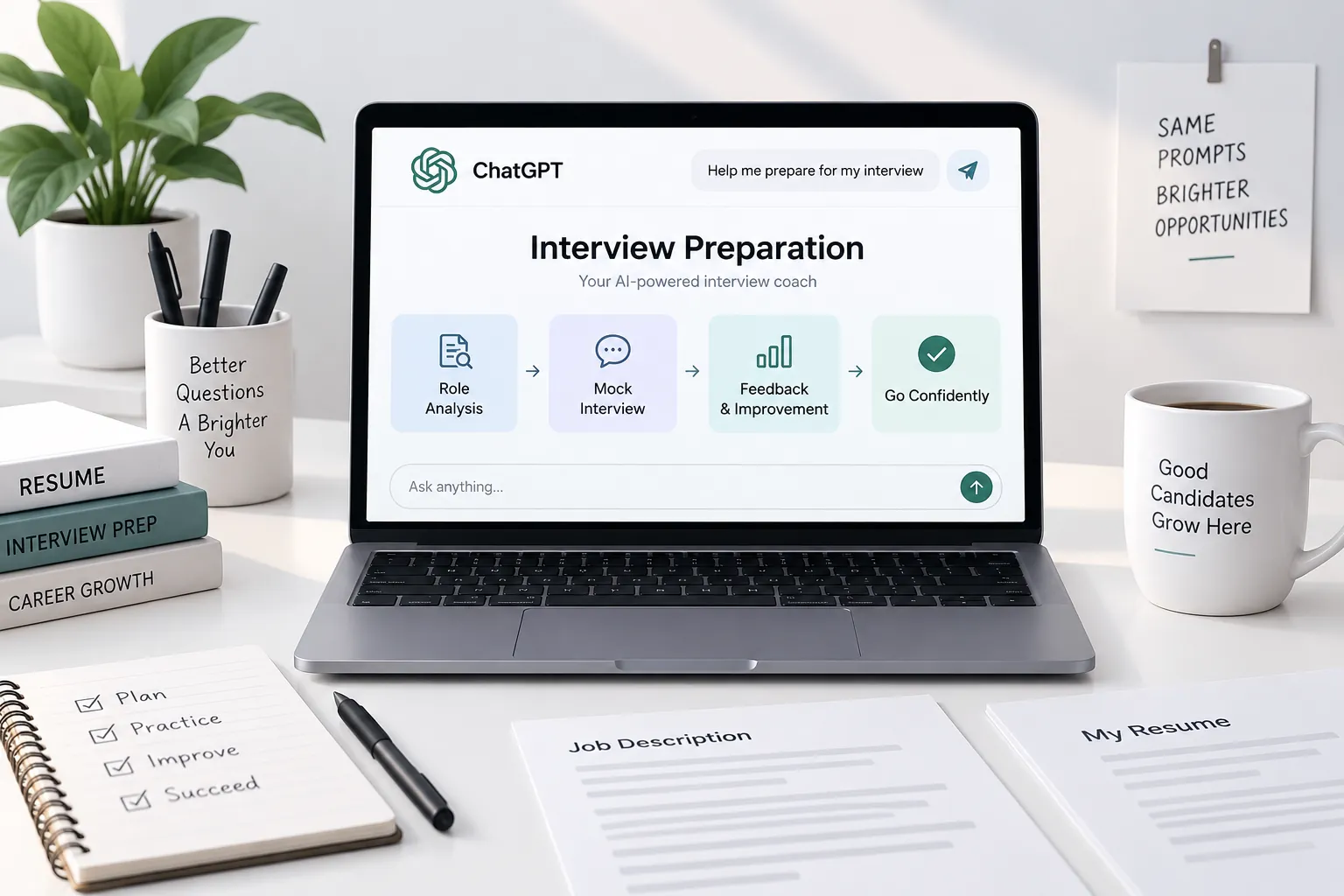
Preparing for an interview can be difficult when you don’t know what to practice first. These ChatGPT prompts for interview preparation turn ChatGPT into a coach, mock interviewer, technical examiner, and recruiter so you can practice with a specific role and job description.
Here’s how to use all 15 prompts, organized by what stage of prep you’re in.
Start With a Plan: ChatGPT Prompts for Interview Prep
Before you touch a single mock question, get the shape of your preparation right. Two prompts handle this.
Tip: Give ChatGPT your actual experience and the specific job description whenever possible. Avoid asking it to invent achievements, qualifications, or work experience. Verify important company and job information before relying on it.
1. Build a personalized interview plan.
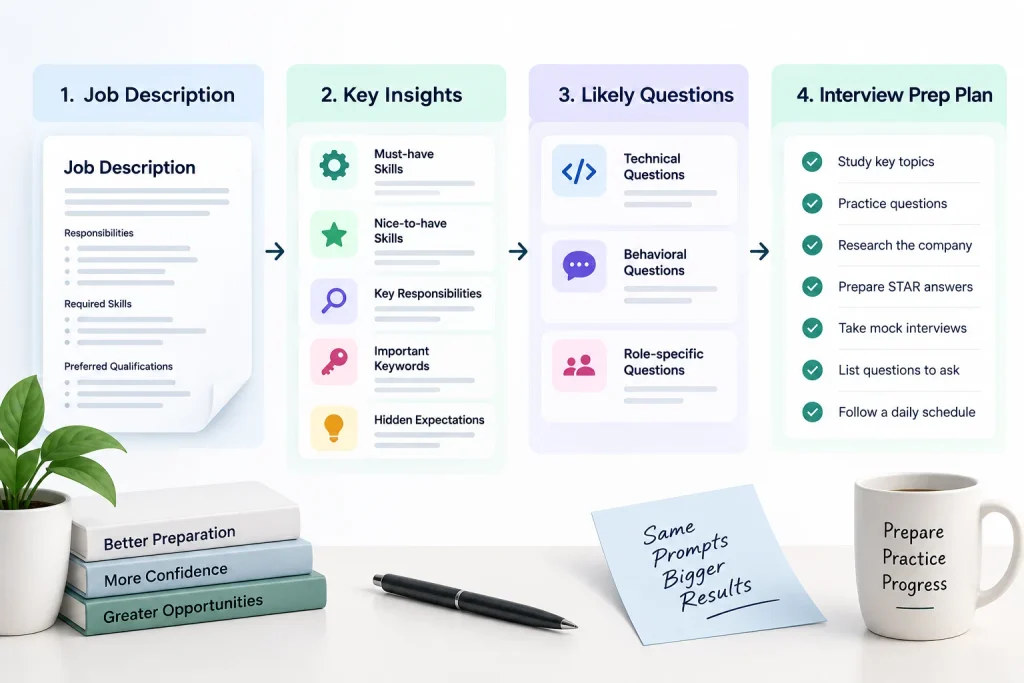
Give ChatGPT your job title, industry, background, and the job description. Ask it to map out technical topics, behavioral questions, company research, and a daily practice schedule, prioritized against what the job actually asks for. This turns a vague “I should prepare” into a checklist with an order to it.
Prompt:
Act as an expert interview coach.
I’m preparing for a [Job Title] interview at a [Company/Industry].
My experience:
[Paste your background]Job description:
[Paste JD]Create a detailed preparation plan covering:
- Technical topics
- Behavioral questions
- Company research
- Role-specific questions
- Mock interviews
- Questions to ask the interviewer
- Daily practice schedule
Prioritize the topics based on the job description.
2. Reverse-engineer the job description.
Paste the JD and have ChatGPT read it the way a hiring manager would. It should surface must-have skills versus nice-to-haves, the keywords buried in the responsibilities section, and the questions those responsibilities are likely to generate. You’ll often spot expectations the posting never says outright.
Prompt:
Analyze this job description like a hiring manager.
Identify:
- Must-have skills
- Nice-to-have skills
- Key responsibilities
- Important keywords
- Likely technical questions
- Likely behavioral questions
- Hidden expectations
Create an interview preparation checklist based only on the information provided.
Practice Under Real Pressure
Reading about interviews and sitting through one are two different skills. This is where most preparation falls apart, so don’t skip it.
3. Run a realistic mock interview.
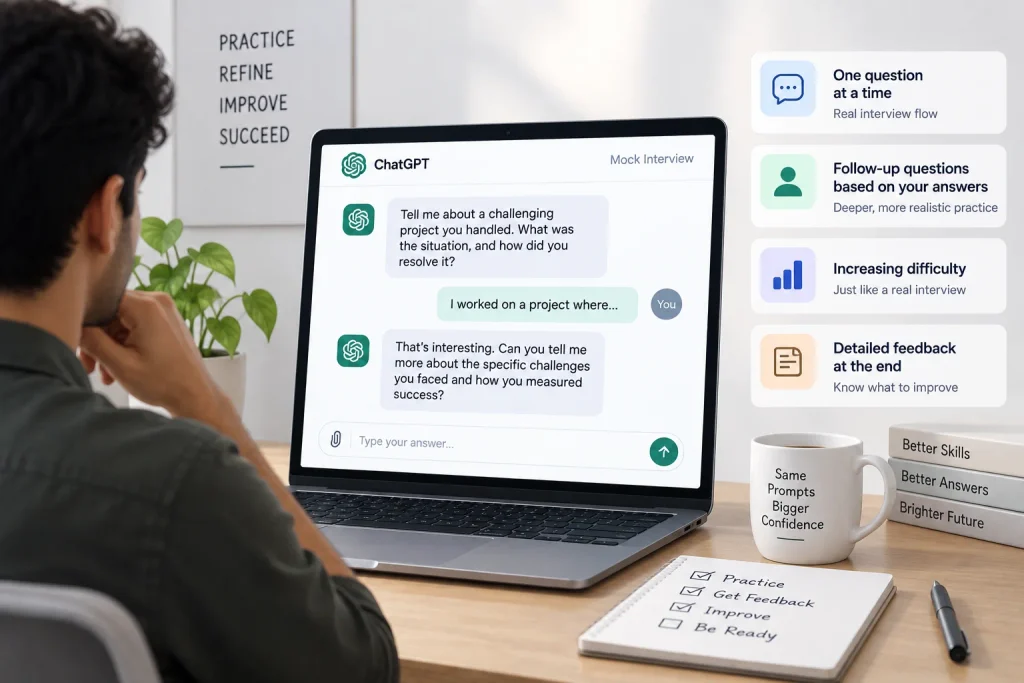
Set the rules upfront: one question at a time, no early answer key, follow-ups based on what you actually say, difficulty that ramps up as you go. Feedback comes at the end, not mid-answer. That structure matters. It’s what makes the practice feel like the real thing instead of a quiz.
Act as the interviewer for a [Job Title] position.
Conduct a realistic interview.
Rules:
- Ask one question at a time.
- Wait for my answer.
- Ask follow-up questions based on my response.
- Don’t give me the ideal answer immediately.
- Gradually increase difficulty.
- At the end, provide detailed feedback.
4. Get your existing answers rewritten.
Already have an answer you’ve used before? Hand it over and ask for a breakdown on relevance, clarity, structure, and impact. The rewrite should stay true to what actually happened. This isn’t about inventing a better story. It’s about telling your real one more sharply.
Here is my interview question and answer:
Question:
[Question]My answer:
[Answer]Evaluate my response for:
- Relevance
- Clarity
- Structure
- Confidence
- Specificity
- Impact
Identify weaknesses and rewrite my answer while keeping it truthful to my actual experience.
5. Convert your experience into STAR answers.
Situation, Task, Action, Result. Describe a real scenario (a conflict, a deadline, a failure you recovered from) and let ChatGPT shape it into the format interviewers are trained to listen for. The instruction to never invent achievements is worth repeating to the model every time.
Help me convert my experience into STAR-format interview answers.
My experience:
[Describe situation]Create answers for:
- Leadership
- Conflict
- Failure
- Problem-solving
- Teamwork
- Difficult stakeholder
- Meeting a deadline
- Taking initiative
Do not invent achievements or experiences.
What STAR Means
Situation, Task, Action, Result (STAR) is a common structure for answering behavioral interview questions. See Indeed’s guide to the STAR interview technique for a deeper explanation.
Go Deep on Technical and Subject Knowledge
If your interview includes a technical round, generic prep won’t cut it.
6. Generate tiered technical questions.
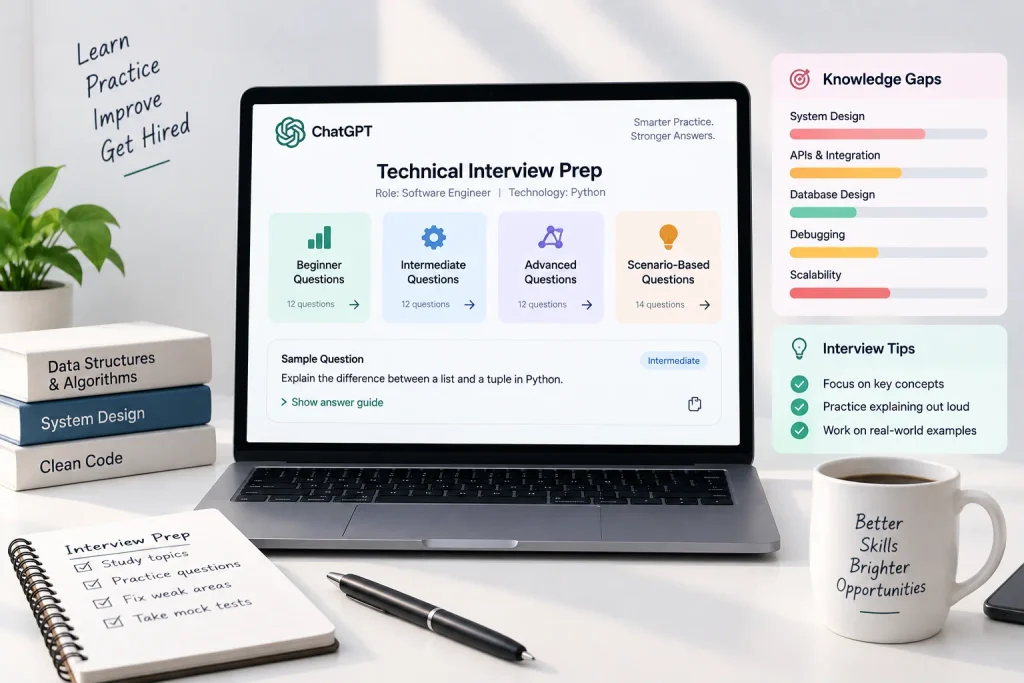
Ask for 50 questions split into beginner, intermediate, advanced, and scenario-based tiers for your specific technology or role. For each one, request what the interviewer is actually testing for, the key points a strong answer hits, and the mistakes people commonly make. That last part is the one candidates usually skip.
Act as a senior technical interviewer for [Technology/Role].
Create 50 interview questions divided into:
- Beginner
- Intermediate
- Advanced
- Scenario-based
For each question provide:
- What the interviewer is testing
- Key points expected in the answer
- Common mistakes
- Follow-up questions
7. Find your weak spots before the interviewer does.
Have ChatGPT quiz you one question at a time on a subject, then tag each answer as strong, needs improvement, or weak. At the end, ask for your top five gaps and a short revision plan targeting exactly those. Targeted beats broad, every time.
Test my knowledge of [Subject].
Ask me 20 questions one at a time.
Track my performance and categorize each answer as:
- Strong
- Needs improvement
- Weak
At the end, identify my top 5 weak areas and create a revision plan.
8. Face tough follow-up questions.
Paste an answer you’re proud of and ask ChatGPT to play a skeptical interviewer, digging for gaps and inconsistencies with ten hard follow-ups. This helps you practice handling the kind of follow-up questions that can expose gaps in your answer.
Take this interview answer:
[Paste answer]
Act like a skeptical interviewer.
Ask 10 challenging follow-up questions that could expose gaps, inconsistencies, or lack of practical experience.
After I answer them, evaluate my responses.
Prepare for the Human Side of the Room
9. Rehearse the HR round.
Tell me about yourself, strengths and weaknesses, career goals, how you handle conflict. These questions feel soft, but they’re where candidates lose momentum. Run them one at a time, with feedback after each response, so you catch your own tendency to ramble before it happens live.
Act as an experienced HR interviewer.
Ask me realistic questions about:
- Tell me about yourself
- Strengths and weaknesses
- Career goals
- Motivation
- Teamwork
- Conflict
- Leadership
- Career changes
- Difficult situations
Ask one question at a time and provide feedback after each response.
10. Learn a concept the way an interviewer will test it.
Pick a topic and ask ChatGPT to cover the definition, how it actually works, a real-world example, and the follow-up questions someone might throw at you once you’ve answered the basic version. A short quiz at the end tells you if it actually stuck.
Teach me [Topic] specifically for a job interview.
Explain:
- Basic definition
- How it works
- Real-world example
- Practical use case
- Common interview questions
- Common mistakes
- Advanced follow-up questions
Finish with a short quiz.
Handle the Advanced Rounds
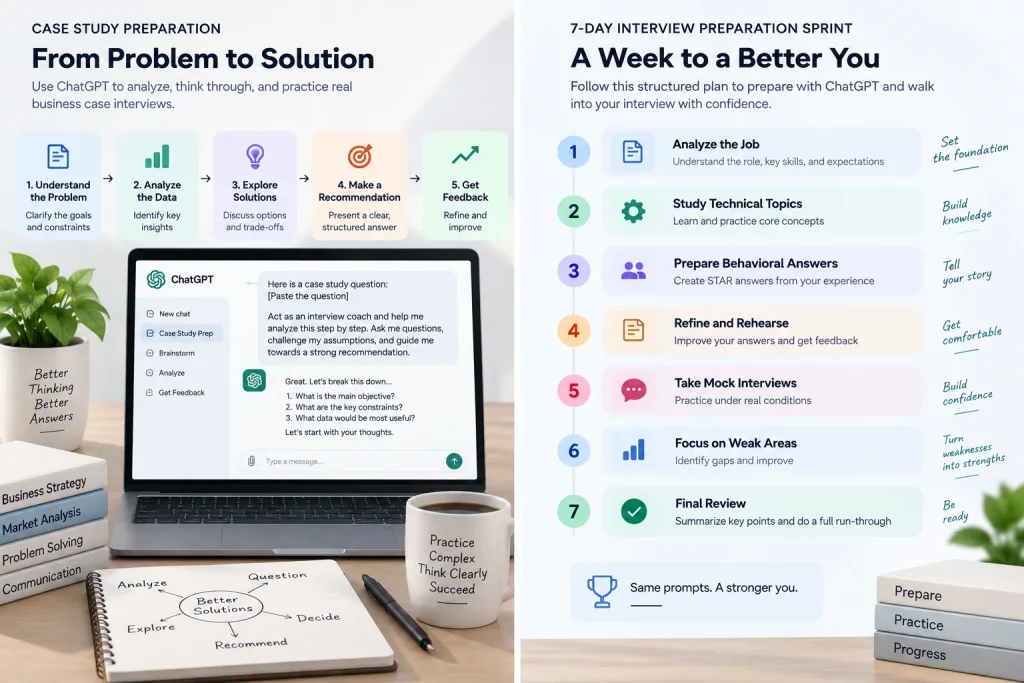
11. Practice a business case study.
Ask for a realistic case tied to your target role, then work through it without being handed the solution. You ask the questions, you make the assumptions, and ChatGPT challenges them. This is the closest you’ll get to a real case interview without booking one.
Give me a realistic business case study for a [Job Title] interview.
Don’t reveal the solution immediately.
Let me analyze the problem and ask questions.
Challenge my assumptions and provide additional information only when I request it.
At the end, evaluate my approach.
12. Build a company-specific playbook.
Name the company and role, paste the job description, and get role-specific questions, likely case studies, and a preparation checklist built around that one company. Ask ChatGPT to flag what’s confirmed by the JD versus what still needs verifying on your end.
Help me prepare for an interview at [Company] for [Role].
Analyze the job description I provide and create:
- Role-specific questions
- Technical topics
- Behavioral questions
- Possible case studies
- Questions I can ask the interviewer
- Preparation checklist
Clearly distinguish information provided by me from information that needs verification.
13. Run a seven-day sprint.
Interview in a week? Give your current prep level honestly, and get a day-by-day plan that front-loads the highest-impact topics first, with mock interviews and revision built into the schedule rather than crammed at the end.
My interview is in 7 days.
Role:
[Job Title]Job description:
[Paste JD]Current preparation level:
[Beginner/Intermediate/Advanced]Create a day-by-day preparation plan.
Include technical preparation, behavioral questions, mock interviews, revision, and final-day preparation.
Prioritize high-impact topics first.
14. Get three perspectives on one answer.
Answer a random question for your role, then have ChatGPT respond as a recruiter, a hiring manager, and a technical expert, each giving separate feedback. Interviewers on a real panel don’t all care about the same thing, so neither should your practice.
Give me a random interview question for a [Role] position.
Wait for my answer.
Then act as three reviewers:
- Recruiter
- Hiring Manager
- Technical Expert
Give separate feedback from each perspective.
Then show me how to improve the answer without making up experience.
15. Combine everything into one master prompt.
This is the “run it all” version: coach, recruiter, hiring manager, and technical interviewer in one conversation, moving from role analysis through mock interview through a final revision plan. Use it when you want the full simulation instead of one piece at a time.
Act as my personal interview coach, recruiter, hiring manager, and technical interviewer.
I am preparing for:
Role: [Job Title]
Company: [Company]
Experience: [Years]
Job Description: [Paste JD]First analyze the role and identify the skills and competencies likely to be assessed.
Then create a personalized preparation strategy covering technical questions, behavioral questions, case studies, role-specific scenarios, STAR answers, mock interviews, and questions to ask the interviewer.
Conduct the mock interview one question at a time.
Challenge my answers with realistic follow-ups.
Do not invent experience on my behalf.
At the end, identify my strengths, weak areas, recurring mistakes, and create a final revision plan.
Making These Prompts Actually Work for You
A few things separate people who get real value from these prompts from people who just paste them in and skim the output.
- Fill in your real background every time. Vague inputs get you vague, forgettable answers.
- Answer out loud before you type, if you can. Interviews are spoken, and typed answers train a different muscle.
- Push back when ChatGPT’s follow-up feels off base. That instinct is worth practicing too.
- Revisit prompt 7 (finding your weak areas) a few days apart. Watching the gaps shrink is its own kind of confidence.
For more prompt frameworks you can adapt to other parts of your job search, check out Business prompts. For more guidance on using ChatGPT for resumes and interview preparation, see OpenAI Academy’s ChatGPT for Resumes and Interviews.
Wrapping Up
The candidates who walk into interviews prepared aren’t the ones who read the most advice. They’re the ones who practiced the actual moment, out loud, under a bit of manufactured pressure, until it stopped feeling foreign.
These ChatGPT prompts for interview preparation are designed to help you structure your preparation, practice realistic interviews, and identify areas that need more work. Copy and paste them into ChatGPT. Adjust the placeholders with your specific career details and start practicing. Take control of your career growth and ace that next interview.
Frequently Asked Questions (FAQs)
Can ChatGPT conduct a mock interview?
Yes, you can prompt ChatGPT to act as a hiring manager or recruiter and ask you behavioral questions or technical questions one at a time. This creates a realistic mock interview environment, allowing you to practice under pressure before the actual day.
What is the STAR method, and can AI help with it?
The STAR method (Situation, Task, Action, Result) is a standard technique for answering behavioral interview questions. You can provide ChatGPT with a rough outline of your past work experience and ask it to structure your story using this framework so your answers are concise and impactful.
Should I memorize the answers generated by ChatGPT?
No, you shouldn’t memorize AI-generated answers word-for-word because they often sound unnatural when spoken aloud. Instead, use these ChatGPT Prompts for Interview prep to outline your thoughts, identify key skills, and match your experience to the job description. Always speak in your own voice.
Can ChatGPT predict my interview questions?
Absolutely. By pasting the job description and your resume into the chat, you can ask the AI to act as a hiring manager and generate the most likely questions they will ask based on the role’s requirements and your specific background.